
SOMETHING TO CHEW ON
First off, many thanks to all in the AV membership for sharing your wisdom & experience in response to those seeking assistance for a wide range of health issues and otherwise. I’ve chimed in when possible, but now realize individual threads go unnoticed by those not involved in a particular discussion group. As a clinician with more years of experience under my belt than I care to admit my perspective is often 180 degrees from the type of this-for-that advice common to the World Wide Web.
If I’m honest, my off-the-cuff answer to most health-related queries would be the same two words, “it depends”. A universal panacea for all that ails us does not exist (well, actually it does exist, but more on that later), nor is there a right or wrong. Each body is a unique laboratory canvas for personal experimentation. The real magic happens when experience proves out the consequences of the thoughts, emotions and actions that we put in play every single moment.
I’ve decided to create a running post, and pin each new installment, so those that care to endure my musings can easily follow, with past articles readily available. I’ll keep a watchful eye on the chat threads, and respond when appropriate, but these forums are where the ample membership talent should get to know each other.
My posts will focus on the fundamentals way upstream from the recipe approaches common to the many sub-groups and cults within alternative & conventional schools of thought alike. There are, of course, practices and technologies that I believe would benefit many, but we’ll qualify those discussions with the when, why and how-to.
So let’s kick this off with the most basic topic of all!
SOMETHING TO CHEW ON
No matter concerning health elicits more spirited debate or daily preoccupation than our most basic lifestyle necessity, that is, the food we eat. Everyone has an opinion in this day of information overload. Ideology and narrow academic perspective confuse the issue more, while differing point of views on what, when & how to eat can at times become downright contentious.
No doubt, there’s much to be said on the issue ranging from bio-individuality, spirituality, performance goals, phase of life & seasonal variations, and often ignored, is the intense nexus between emotions and what we consider the sustenance of life itself.
No aspect of human foraging will suffer neglect on this continuing forum, but today we’ll address that most universal admonishment most can recall from early childhood. Chew your food!
“Eat your food like it’s medicine, or someday you’ll be eating medicine like it’s food.”
SO MANY MEMORIES
Before food even touches the lips, the sense of smell messages the amygdala and hippocampus in the limbic area of the brain to retrieve emotions and memories linked to long past events and the significant others that have crossed life’s path. A cascade of neuroendocrine events at once puts the digestive tract in its entirety on notice, while every anatomical region both physical and etheric plays a vital role.
The stomach can be likened to the eye of emotional turbulence in both its positioning within the solar plexus and physiological function. There’s good reason why feelings ranging from nervous upset to “something just doesn’t feel right” seem to target this area of our inner landscape. As the first organ to receive foodstuff just downstream from the mouth, it takes the brunt of any sense of hurry or angst during repast, while insufficient mastication adds excessive fuel to the digestive fire.
SIDE BAR: A very helpful technique that I often use when encountering a client in extreme distress is to lightly touch a pair of reflexes 1 inch below the hairline at mid eyebrow with the pads of the index and middle fingers until a strong and synchronous pulse is felt on both sides. These forehead points, and others throughout the cranium, were discovered by an Osteopath by the name of Terrence Bennett, and prove amazingly effective in calming the emotional body.
On these topics many a book could be written, but let’s cut to the taste. Some 10,000 lingual receptors are flooded with information with every single bite of food. Nature’s five flavors share a physiological kinship with the five primary Yin organs, and a balanced palate stimulates the neurological networks of each of these vital centers in equal measure.
This qualitative interplay commencing in the oral cavity is only half of the gustatory equation, however, as the flip side is about the exchange of hard data.
YOUR CELLS KNOW
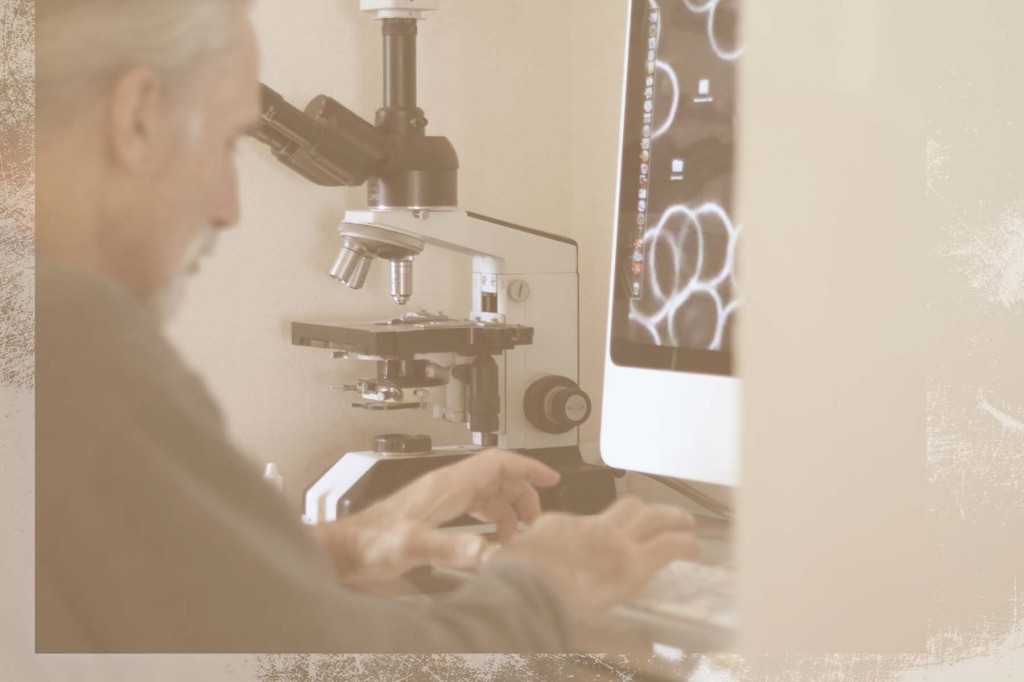
The most basic yet revealing of my laboratory investigative procedure that I did on every patient visit was the visualization of Cell Debris in the urine. A trained eye can ascertain the relative number of spent cells in PPM by projecting a concentrated light beam through a test sample. It takes just a smidgen of rocket science to understand this value within a larger mathematical context for clinical application, but here’s the take-away for our present discussion.
Cell Debris is the best indicator for discerning the Bioterrain’s bottom line. If the ratio of cell mortality vs cell regeneration, as observed by the degree of urine opaqueness, tends to one side or the other of the physio-electric scale it reveals either an active process, or the inability to remove organic waste.
As the brilliance of Natural Design would have it, these exhausted cells have one final post mortem mission. Genetic material and other elements from fragmented cells message living cells with precise directives from the intelligence hierarchy. The salivary glands serve as an end destination depository for this coded material after it enters circulation.
Following an initial olfactory screening, nerve receptors on the tongue deliver an additional therapeutic jolt to target tissues through a lingual decoding process. The final mingling of saliva with food tags nutrients to directly route to a specific biological address.
Now we come full circle to that maternal mantra of “chew your food!” Deriving nutrition at mealtime is anything but haphazard, as everything a body needs is signed, sealed & addressed for delivery while still in the mouth. Ideally, eating would best be approached as a meditative practice. When is the last time you savored the aroma of a meal, and contemplated the transmutative magic as it occurred with every enjoyable bite?
As with all good things in life, it boils down to gratitude & impeccability and much less about the opinions of the intellect.
Bon appétit!
Dr. Barre Lando